
Topic Risk Management,
Share
What HR Mistakes Can Actually Get Your Company Sued?
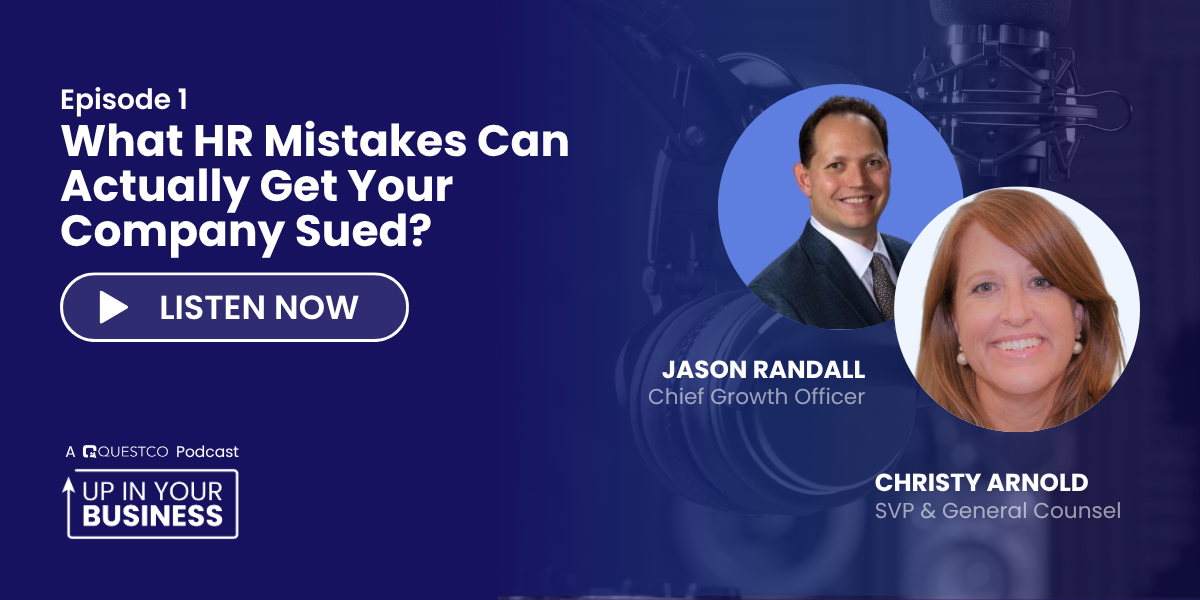
The following article builds from Jason Randall’s conversation with Christy Arnold, General Counsel and SVP at Questco, on Episode 1 of Up In Your Business.
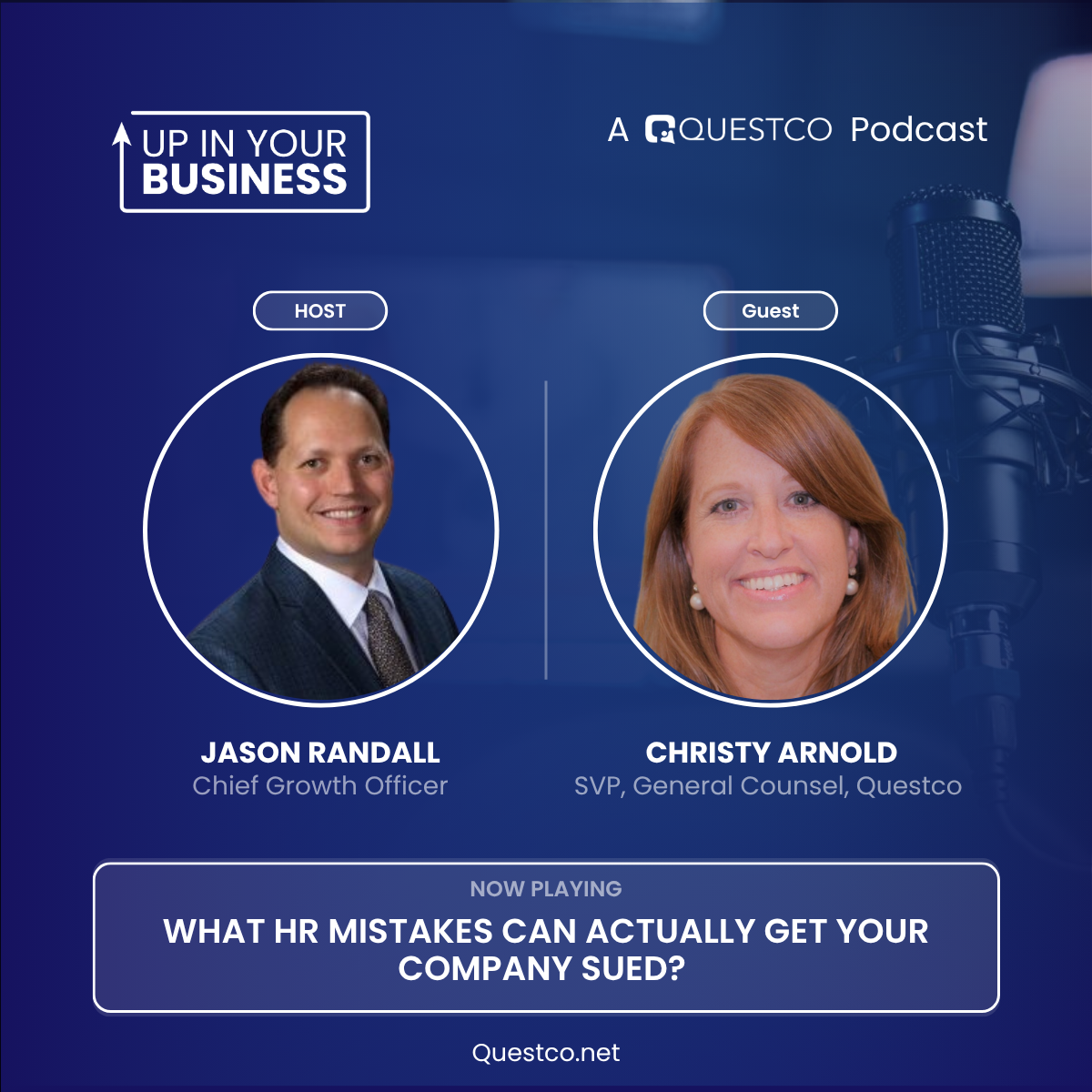
Christy has spent nearly three decades practicing law and has worked deeply in employee benefits, PEOs, HR compliance, state regulation, and employment law. In the episode, she and Jason discuss the HR mistakes that can create real business risk: misclassification, hiring technology, poor documentation, inconsistent policies, and terminations that surprise the employee.
In this companion article, we’ll go deeper into:
- Why an EEOC charge can become an 11-month operational burden, even before a lawsuit
- Why worker classification decisions are not just “payroll preferences”
- How hiring tools, tests, and AI screeners can create discrimination risk
- Why documentation is less about “covering yourself” and more about proving what actually happened
- Why a handbook does not protect a company if managers apply policies inconsistently
- Why manager training may be the highest-leverage HR risk reducer
HR risk is not only created by bad decisions. It is often created by undocumented, inconsistent, or poorly explained decisions. A business can make the right call and still have a hard time defending it.
Table of Contents
- What happens after an employee files an EEOC charge?
- Why do “small” employee issues escalate?
- Why is employee misclassification so risky?
- When does “salary” not mean exempt?
- Can hiring software or AI tools create discrimination risk?
- Why is documentation more than a paper trail?
- What makes a termination defensible?
- Why are policies not enough?
- What should leaders fix first?
- What should leaders take away from this episode?
- Frequently Asked Questions
- Need help tightening your HR risk?
Listen to the Up In Your Business Podcast

What happens after an employee files an EEOC charge?
An EEOC charge starts a formal process that can require written responses, documents, witness information, and months of management attention.
The EEOC says that when a charge is filed against an employer, the agency notifies the employer within 10 days and gives access to the charge through its Respondent Portal. The employer may then need to submit a position statement, respond to requests for information, produce personnel files or policies, participate in interviews, and preserve relevant documents. The EEOC also says the average time to investigate and resolve a charge was about 11 months in 2023. (EEOC)
That timeline explains why Christy’s point matters. A weak HR process does not have to become a courtroom drama to become expensive. It can become expensive because leaders are pulled into reconstruction mode.
Questions that come up later
- Who said what?
- When was the employee warned?
- Was the same rule applied to others?
- Did the manager document the conversation?
- Was this decision made before or after the employee raised a concern?
If the answer lives only in someone’s memory, the business is already working uphill.
Why do “small” employee issues escalate?
Small employee issues escalate when they are not addressed clearly, consistently, or early enough to prevent misunderstanding.
Christy’s most important point in the episode is not a legal technicality. It is a management reality: people often avoid tough conversations because they hope the problem will resolve itself. In her experience, many workplace issues that later become claims begin as minor concerns that were not addressed directly.
That is not a theory about human nature. It shows up in the structure of the EEOC process itself. Once a charge is filed, the EEOC may ask for personnel policies, personnel files, information about similarly situated employees, and witness interviews. (EEOC)
The agency is not just asking, “What happened on the final day?” It is asking, “What pattern led to this?”
That is why ignored issues are dangerous. An employee complaint that was never answered can later look like indifference. A performance issue that was never documented can later look manufactured. A manager’s informal “we’ll see how it goes” can later collide with a sudden termination.
The fix is not to turn every conversation into a legal memo. The fix is to close the gap between what managers think they communicated and what the employee actually heard.
Why is employee misclassification so risky?
Employee misclassification is risky because it can affect minimum wage, overtime, benefits, tax treatment, and recordkeeping obligations.
The U.S. Department of Labor defines misclassification under the Fair Labor Standards Act as treating a worker who is an employee under the FLSA as an independent contractor. The DOL says misclassified employees may not receive minimum wage, overtime pay, or other legal protections they are entitled to receive. (DOL)
Christy also points to another common classification issue: exempt versus non-exempt employees. That matters because the FLSA generally requires most employees to be paid overtime at not less than one and one-half times their regular rate for hours worked over 40 in a workweek. The DOL also makes clear that job titles do not determine exempt status; the employee’s duties and salary must meet the regulatory requirements. (DOL)
Common assumptions that create risk
- “We’ll call them a contractor.”
- “We’ll put them on salary.”
- “We don’t have time to track hours.”
- “This role feels professional enough.”
Classification is not based on convenience. It is based on the actual work relationship and legal tests.
Christy’s warning in the episode is especially practical: if a non-exempt employee is paid salary but no one tracks hours, the employer may have very little evidence if the employee later claims unpaid overtime.
When does “salary” not mean exempt?
Salary does not automatically mean exempt. Under the FLSA, exemption generally requires both salary and duties tests.
The DOL’s guidance on white-collar exemptions says employees generally must be paid on a salary basis at not less than $684 per week and meet specific job-duty requirements. It also states plainly that job titles do not determine exempt status. (DOL)
That is the part many managers miss. They hear “salary” and think “no overtime.” But the law asks what the person actually does.
For example, the DOL says blue-collar workers performing repetitive operations with physical skill and energy are not exempt under the white-collar regulations, no matter how highly paid they are. Its examples include construction workers, electricians, mechanics, plumbers, iron workers, and similar roles. (DOL)
The question is not, “Do we pay this person a salary?” The question is, “Does this role legally qualify for the exemption we are using?”
Can hiring software or AI tools create discrimination risk?
Yes. Hiring software, tests, and AI tools can create discrimination risk if they intentionally discriminate or disproportionately exclude people in protected groups without a lawful justification.
The EEOC’s technical assistance on employment tests and selection procedures says employers use many kinds of screening tools, including cognitive tests, physical ability tests, work samples, medical exams, personality tests, integrity tests, criminal background checks, credit checks, performance appraisals, and English proficiency tests. The EEOC warns that these tools can violate federal anti-discrimination laws if they are used intentionally to discriminate or if they disproportionately exclude people based on protected characteristics and cannot be justified under the law. (EEOC)
Christy notes in the episode that employers often assume a large vendor has already handled the legal risk. That assumption is dangerous. Vendor tools can help move hiring faster, but the employer still needs to understand what the tool is doing, what criteria it uses, and whether the contract addresses liability, audits, and compliance.
Recent research supports the concern. A 2024 study of language-model-based resume screening found that the models studied favored White-associated names in 85.1% of cases and that Black males were disadvantaged in up to 100% of cases in some scenarios. (arXiv)
A separate 2026 large-scale resume audit involving 36,880 applications to 9,220 job ads found that, in management occupations, callbacks were 28% to 43% lower for several demographic groups compared with otherwise identical White men. (arXiv)
If the tool affects who gets seen, interviewed, ranked, rejected, or advanced, the employer should be able to explain how it works.
Why is documentation more than a paper trail?
Documentation is more than a paper trail because it is how the business proves expectations, timing, consistency, and the reason for a decision.
The EEOC requires employers to keep personnel or employment records for one year, and if an employee is involuntarily terminated, personnel records must be kept for one year from the date of termination. Payroll records must generally be kept for three years under ADEA and FLSA-related recordkeeping requirements. When an EEOC charge is filed, employers must retain records related to the charge until final disposition. (EEOC)
That is the formal requirement. But the practical value is bigger.
Documentation answers the questions that come later
- Was the employee told what needed to improve?
- Did the manager give a timeframe?
- Was the same standard applied to similar employees?
- Did the company follow its own policy?
- Was the decision made before or after a protected complaint or leave request?
Christy’s point about terminations is sharp: companies often believe “everyone knew” an employee was underperforming, but when they look at the file, there is no record showing that the employee was actually told.
What makes a termination defensible?
A termination is easier to defend when the employee was not surprised, the expectations were clear, the issue was documented, and the company applied its policies consistently.
Christy offers a clean test in the episode: if an employee is blindsided by the termination, the company probably did not manage the process well enough.
That does not mean every termination needs months of warnings. Some situations require immediate action. But in performance-based cases, surprise is a warning sign.
A defensible performance termination usually has a visible path
- The role expectation was clear.
- The employee missed the expectation.
- The manager addressed the issue.
- The conversation was documented.
- The employee was told what needed to change.
- The company followed its policy or documented why an exception was necessary.
- Similar issues were handled in a similar way.
If the company cannot show that path, the termination may still be legitimate. It is just harder to prove.
A termination is not evaluated only by whether the company was frustrated enough to act. It is evaluated by what the company can show.
Why are policies not enough?
Policies are not enough because a policy that is not followed consistently can become evidence of inconsistency rather than evidence of compliance.
A handbook matters. But a handbook is not a magic shield.
If the policy says one thing and managers do another, the policy may create more questions than answers. Why was this employee disciplined but another was not? Why did this manager skip a step? Why did the company follow the policy in one situation but not in another?
The EEOC’s guidance on selection procedures illustrates the broader principle. A neutral procedure can still create legal problems if it disproportionately excludes people in a protected group and is not job-related and consistent with business necessity. (EEOC)
A good manager should be trained to ask: “How have we handled this before?”
What should leaders fix first?
Leaders should fix manager training first because managers are usually the first point of risk.
Managers hear the complaint. Managers deliver the feedback. Managers approve schedules. Managers apply policies. Managers decide whether an issue is worth escalating. Managers document, or fail to document, the conversation.
Christy identifies manager training as the simplest starting point for reducing HR risk. The goal is not to turn managers into attorneys. It is to give them enough structure to know when to act, when to document, and when to involve HR.
Manager training should cover:
- how to have direct performance conversations
- what to document after a coaching conversation
- when to involve HR
- how to handle complaints without minimizing them
- how to apply policies consistently
- how to recognize accommodation, leave, discrimination, retaliation, or wage issues
- what not to say during discipline or termination conversations
The highest-leverage HR work is often not dramatic. It is getting managers to stop relying on instinct alone.
What should leaders take away from this episode?
The most useful takeaway is that HR risk becomes easier to manage when businesses turn vague management moments into clear records, consistent decisions, and earlier conversations.
Practical habits that reduce risk
- If an issue is repeated, document it.
- If a policy exists, follow it.
- If a worker’s classification is unclear, review it before it becomes a wage claim.
- If a hiring tool screens candidates, understand the tool before trusting it.
- If a manager is uncomfortable having a direct conversation, train them before the issue escalates.
Christy’s message is not that every employer is one mistake away from disaster. It is that many expensive disputes begin with fixable gaps: unclear communication, weak documentation, and inconsistent follow-through.
Good intentions help. Good records help more.
Frequently Asked Questions
What HR mistakes most often create legal risk?
The HR mistakes that commonly create legal risk include employee misclassification, poor documentation, inconsistent policy enforcement, mishandled terminations, failure to address employee complaints, and unreviewed hiring or screening tools.
Is employee misclassification only about independent contractors?
No. Misclassification can involve treating an employee as an independent contractor, but it can also involve classifying a W-2 employee incorrectly as exempt or non-exempt for overtime purposes. Both can create wage and hour risk. (DOL)
Does paying someone a salary mean they are exempt from overtime?
No. The DOL says job titles do not determine exempt status. Employees generally must meet salary and duties tests to qualify for white-collar exemptions under the FLSA. (DOL)
Can AI hiring tools create discrimination risk?
Yes. Hiring tools and other selection procedures can create risk if they intentionally discriminate or disproportionately exclude people in protected groups without a lawful justification. The EEOC applies anti-discrimination principles to selection procedures, and recent research has found measurable bias in some resume-screening models. (EEOC)
How long can an EEOC charge take?
The EEOC says the average time to investigate and resolve a charge was about 11 months in 2023. Some matters may resolve faster, while others can take longer depending on complexity, cooperation, and whether litigation follows. (EEOC)
Why does documentation matter before termination?
Documentation matters because it shows what expectations were communicated, what issues occurred, how the company responded, and whether the employee had notice before termination. It also helps the company respond if an agency requests personnel files, policies, or other evidence.
What is the first thing a business should improve to reduce HR risk?
Manager training is often the best first step. Managers need to know how to address concerns early, document performance issues, apply policies consistently, and escalate sensitive issues before they become claims.
Build a clearer path before the next issue escalates
Questco helps businesses strengthen the everyday systems behind better HR decisions: manager support, compliance guidance, documentation practices, payroll, benefits, and employee relations.
If this episode raised a question about how your team handles people issues, classification, documentation, or terminations, talk with Questco about building a clearer path before the next issue escalates.


