Topic Risk Management,
Share
What Happens If You Fire Someone the Wrong Way?
Firing someone the wrong way can expose a business to claims, disputes, legal costs, unemployment complications, and months of cleanup. But as Santos Alvarenga explains in this episode of Up In Your Business, the biggest risk usually starts before the termination meeting itself.

Were expectations clear? Was the issue documented? Were policies applied consistently? Did the manager coach the employee before deciding to let them go? Did HR review the decision before the conversation happened?
In the episode, Jason Randall frames termination as one of the hardest things leaders have to do. It is emotional, uncomfortable, and easy to mishandle. Santos’s answer is not to make termination colder or more corporate. Her point is more practical: if an employer wants to protect the business, the employee should not be surprised by the decision.
Termination risk usually starts before the termination meeting. It starts with what the company did, documented, reviewed, and communicated earlier.
Table of Contents
- Why is “at-will employment” not enough protection?
- Where does termination risk usually begin?
- Why do managers avoid documenting performance issues?
- What does good documentation actually look like?
- Why does consistency matter when firing an employee?
- How can emotion make termination risk worse?
- What should happen during the termination conversation?
- When should HR get involved?
- Is there a “right” amount of time before firing someone?
- What should leaders do first if they may need to fire someone?
- What is a better way to think about termination?
- Listen to the full episode
- Frequently Asked Questions
Why is “at-will employment” not enough protection?
At-will employment does not mean an employer can fire someone without risk.
Santos says many leaders assume the risk is minimal because they operate in an at-will state. They think, in her words, “there is no repercussion.” Or if there is one, they assume it only affects unemployment.
An employee can still challenge a termination. They can claim retaliation, discrimination, inconsistent treatment, leave-related issues, or other concerns. And if the company does not have concrete documentation showing why the decision was made, the employer may spend months defending a decision that could have been much easier to explain.
At-will employment may give employers flexibility. It does not erase context.
Where does termination risk usually begin?
Termination risk usually begins at the beginning of employment, not at the end.
One of Santos’s strongest points is that managers often know early when an employee may not be working out. They see missed expectations. They notice performance gaps. They sense that someone does not understand the job or is not meeting standards.
But instead of documenting the issue, starting a disciplinary process, or putting the employee on a performance improvement plan, they wait.
If you knew from the beginning, why did no one write it down?
Many termination problems are not caused by one dramatic mistake in the final meeting. They are caused by months of avoidance, vague feedback, undocumented conversations, and managers hoping the issue will solve itself.
Why do managers avoid documenting performance issues?
Managers often avoid documenting performance issues because they do not want to be the bad guy.
Santos names the human part directly. Managers do not always want to discipline an employee. They do not want to tell someone they are doing a bad job. They may not want to damage the relationship, ruin the mood, or turn a friendly workplace dynamic into something formal.
Santos compares the manager-employee relationship to a marriage in one important sense: it requires communication. If something is not working, both sides need to know. If a manager waits until termination to make the problem clear, the employee may feel shocked, blindsided, or mistreated.
A surprised employee is more likely to push back. A company with no documentation is less prepared to respond. The manager who avoided one hard conversation may end up creating several harder ones.
What does good documentation actually look like?
Good documentation shows the issue, the expectation, the follow-up, and the consequence.
Santos makes a useful distinction: documentation is not just writing “I talked to the employee.” That may be a note, but it does not necessarily prove that the employee understood the concern or knew what would happen next.
Better documentation answers questions like:
- What specific issue occurred?
- When did it happen?
- What expectation was communicated?
- Did the employee understand the expectation?
- What follow-up was provided?
- What happens if the issue continues?
- Was HR copied or involved where appropriate?
For behavior issues, documentation may include a warning or disciplinary action. For performance issues, Santos points to a performance improvement plan. If someone is making work mistakes they should not be making, the business needs a record of what is wrong, what improvement is expected, and what support or timeline has been provided.
Documentation should be specific, consistent, and actionable. Vague notes are not enough.
Why does consistency matter when firing an employee?
Consistency matters because inconsistent enforcement makes a termination harder to defend.
If one employee is fired for being late once, but other employees have been late without discipline, the company has created a problem. If one employee is terminated for leaving early, but that rule has not been enforced with others, the decision may look selective.
Santos gives an example from her consulting work. A client wanted to terminate an employee because leadership felt the employee was “off” and the manager no longer wanted to work with him. When Santos asked what the actual issue was, the answers were vague. The employee complained too much. The CEO wanted him gone. He had shown up late once. He had left early.
The problem was not just the lack of a strong reason, but consistency. The company did not normally terminate employees for those same issues. So if they did it here, the decision could appear targeted, emotional, or unsupported.
Consistency does not mean every situation gets the exact same response. It means the company can explain why similar situations were handled in similar ways, or why different facts justified a different result.
How can emotion make termination risk worse?
Emotion makes termination risk worse when leaders move too fast, skip steps, or accept a manager’s frustration as enough reason to fire someone.
Santos’s example shows how easily this happens. A leader wants someone gone. The manager is frustrated. Internal HR may “go with the flow.” Nobody stops long enough to ask the harder questions.
Questions to ask before acting
- What actually happened?
- What policy was violated?
- Was the employee warned?
- Was the same policy enforced with others?
- Are there any protected issues involved?
- Is the timing risky?
- Has the employee recently raised a concern?
- Is there documentation?
Santos also flags how casual language can create risk. In the example she shared, the client kept describing the employee as “crazy.” That kind of offhand comment can open up a much more complicated issue, especially if mental health or disability concerns may be involved.
Frustration is not documentation. Annoyance is not cause. “The manager does not want to work with him anymore” is not a termination file.
What should happen during the termination conversation?
The termination conversation should be clear, controlled, and supported by HR or another appropriate witness.
Santos says a termination should not be a shock if the company has handled the earlier steps well. The employee may not like the outcome, but they should understand how the business got there.
For the actual conversation, Santos recommends having the manager and an HR professional in the room. The manager should not handle the meeting alone. A second person provides support, helps keep the conversation on track, and creates a witness to what was said.
As for how much detail to share, Santos gives a very practical answer: it depends. For attendance issues, it may make sense to walk through dates and prior warnings. For a harassment termination after an investigation, less may be more.
A good termination meeting is not a debate. It is not a chance to relitigate every moment. It is a clear communication of a decision the company should already be prepared to support.
When should HR get involved?
HR should get involved as soon as a leader thinks termination may be coming.
Santos’s immediate answer is simple: call HR.
That does not only apply to Questco clients. The larger point is that leaders should bring in someone who understands HR process, documentation, state requirements, final pay rules, termination notices, and risk assessment before the decision becomes irreversible.
Even when the termination is well supported, the employer still has to manage the process correctly. Final pay rules vary by state. Some states require specific notices. The company may also need to consider timing, leave status, prior complaints, protected activity, or whether the documentation supports the stated reason.
If the risk is too high, HR may recommend slowing down, documenting more, or taking another step before termination. That pause can feel frustrating to a leader who wants the issue over. But it is often the pause that prevents a bigger mess.
Is there a “right” amount of time before firing someone?
There is no universal amount of time that makes a termination safe.
Santos pushes back on the idea of a perfect waiting period. Whether the employee has been with the company for three months, six years, or nine years, the question is not simply how long they have worked there.
The better question is whether the company has documented the issue and treated the employee consistently.
Timing matters less than readiness.
What should leaders do first if they may need to fire someone?
Leaders should first identify where the employee actually stands and start documenting the issue clearly.
Before jumping to termination, the business should understand the current situation.
Questions to answer first
- What is the actual issue?
- Is it performance, behavior, attendance, misconduct, or something else?
- Has the employee been told?
- Has the expectation been documented?
- Has the company followed its own policy?
- Have similar employees been treated the same way?
- Is HR aware?
- Are there any leave, disability, retaliation, or protected activity concerns?
Once those questions are answered, the company can decide the next step with more confidence.
Sometimes the right move may be termination. Sometimes it may be a written warning, a performance improvement plan, coaching, an investigation, or a clearer policy conversation. The point is to make the decision stronger, cleaner, and less likely to turn into an avoidable dispute.
What is a better way to think about termination?
Strange as it may be, the best termination process begins, in generic form for every single employee, when the person is hired.
Strong terminations are built on clear expectations, early feedback, consistent documentation, and leaders who are willing to have uncomfortable conversations before the situation becomes urgent.
A business does not need to turn every people issue into a paper-pushing nightmare. But it does need a record that shows what happened, what was communicated, and why the final decision made sense.
What is documented gets defended.
Documentation is not bureaucracy for its own sake. It is the business’s memory. It is the record of fairness. It is the difference between a decision that can be explained and a decision that has to be reconstructed after the fact.
Hear the full conversation with Jason Randall and Santos Alvarenga
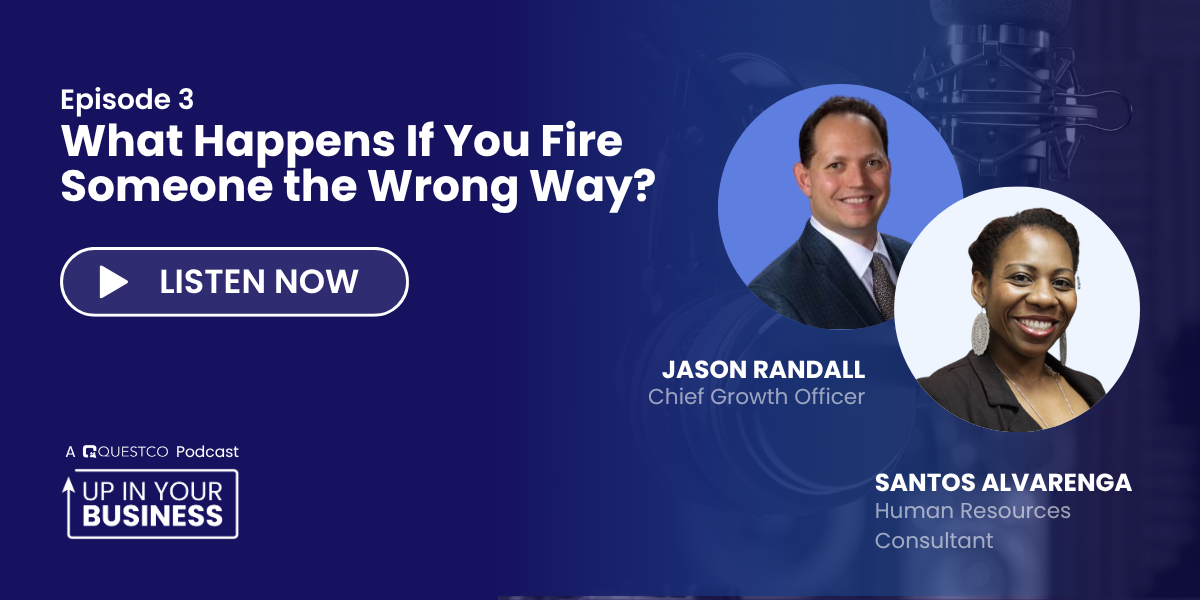
In this episode of Up In Your Business, Jason Randall and Santos Alvarenga discuss what happens when an employee termination is handled poorly, why documentation matters, and how leaders can reduce HR risk before the final conversation.
Frequently Asked Questions
What happens if you fire someone the wrong way?
If you fire someone the wrong way, the business may face retaliation claims, discrimination claims, unemployment disputes, or months of administrative and legal cleanup. The risk is higher when the company lacks documentation, applies policies inconsistently, or cannot clearly explain the reason for termination.
Does at-will employment mean you can fire someone for any reason?
At-will employment gives employers flexibility, but it does not remove all risk. Employers still need to avoid unlawful reasons for termination, such as retaliation or discrimination, and they need documentation that supports the decision.
What documentation do you need before firing an employee?
Useful documentation may include follow-up emails, disciplinary forms, performance improvement plans, attendance records, investigation notes, and written warnings. The documentation should show the issue, the expectation, the follow-up, and the consequence if the issue continues.
Should an employee be surprised by a termination?
In most performance or attendance situations, an employee should not be surprised by a termination. If expectations were communicated clearly and documented consistently, the employee should understand that termination is a possible outcome.
Who should be in the room during a termination meeting?
A manager and an HR professional should typically be present during a termination meeting. The manager should not handle the conversation alone because a second person can support the process, help keep the conversation focused, and serve as a witness.
When should HR get involved in a potential termination?
HR should get involved as soon as a leader thinks termination may be coming. HR can review documentation, assess risk, check state-specific requirements, help with final pay or notices, and recommend whether the company is ready to move forward.
Is a performance improvement plan always required before termination?
A performance improvement plan is not always required, but it can be useful when the issue is related to job performance rather than behavior or misconduct. The right step depends on the facts, the company’s policies, the employee’s history, and the level of risk involved.
Need support with employee relations and termination risk?
For more support with HR compliance, documentation, employee relations, and termination best practices, connect with Questco.