
Topic Risk Management,
Share
Do You Really Need HR Support, or Are You Fine Without It?
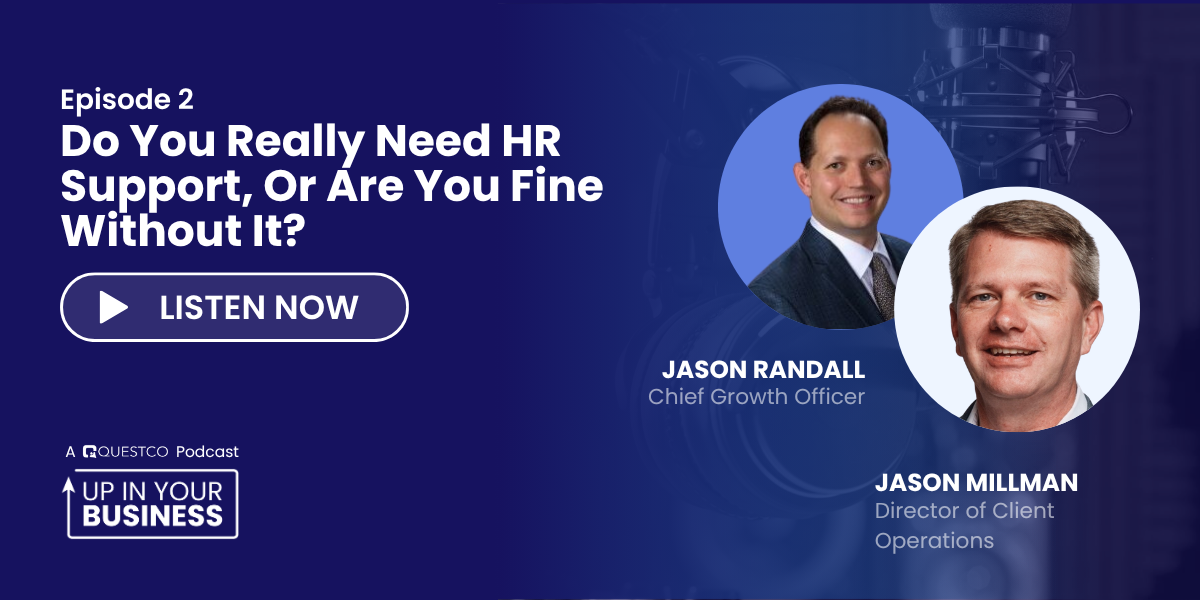
The following article builds from Jason Randall’s conversation with Jason Millman, Director of Client Operations at Questco, on Episode 2 of Up In Your Business.
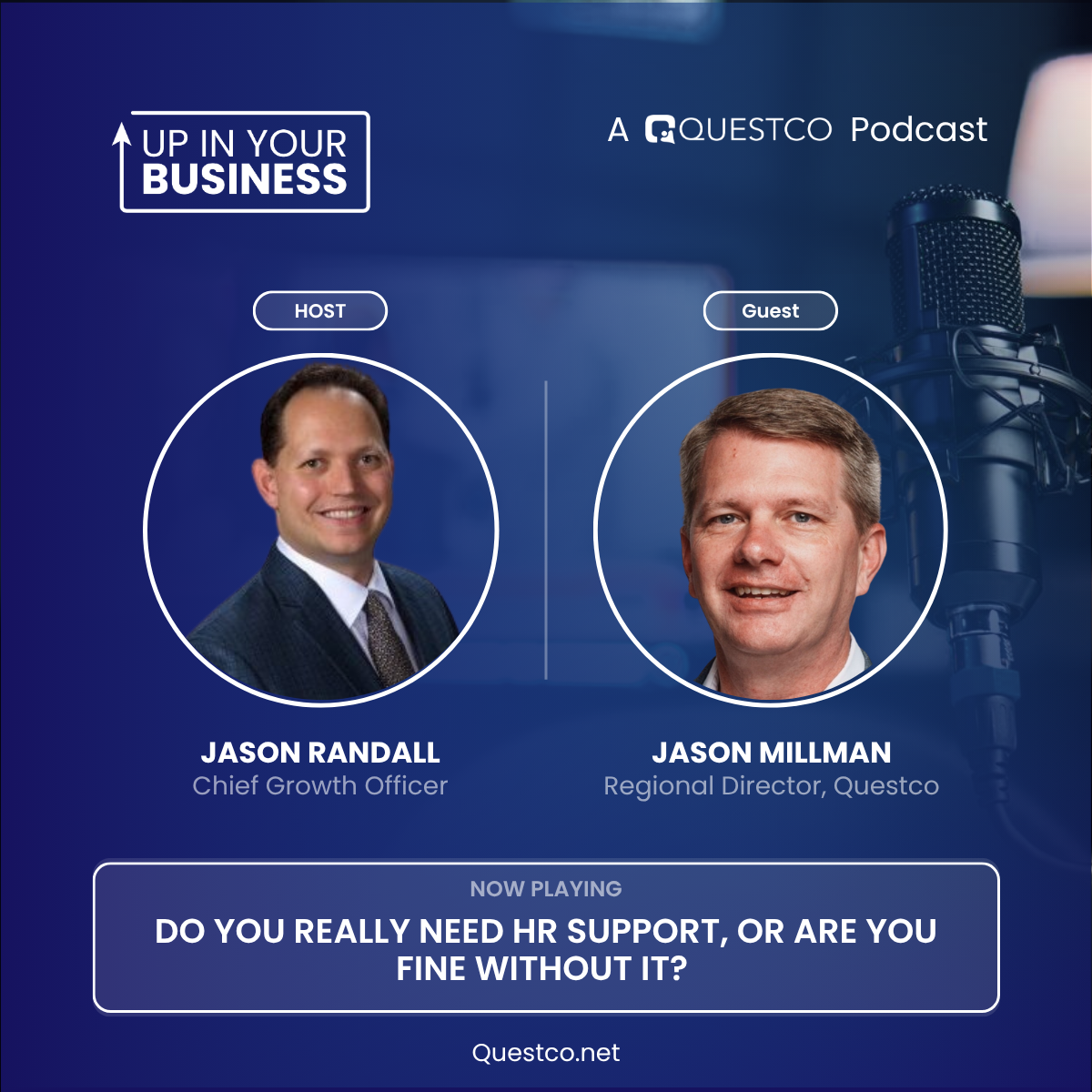
Millman has spent more than a decade helping business owners bring structure, clarity, and support to the people side of their companies. In the episode, he explains what it usually means when a business says it is “fine without HR,” how that changes as the business grows, and why the real problem is often not the absence of HR as a department but the absence of consistent structure.
In this article, we’ll go deeper into:
- Why “we’re fine without HR” often means “nothing serious has gone wrong yet”
- The difference between a lean business and an underbuilt one
- Why managers need tools, training, and follow-up before they are asked to make people decisions
- How inconsistency becomes risk in hiring, onboarding, employee issues, and terminations
- Why the first HR hire often gets stuck reacting instead of building
- How to choose between internal HR, technology, and a PEO partner
- Why human guidance still matters in HR decisions that depend on context
Every business is already making people decisions. The question is whether those decisions are supported by structure.
That is the real tension in this episode. It is not “HR or no HR.” It is whether the business has enough consistency to keep growing without pulling leaders back into every people issue.
Table of Contents
- What does “we’re fine without HR” really mean?
- When does informal HR start to break down?
- What is the difference between lean and underbuilt?
- Why does inconsistency create risk?
- What does an underbuilt termination look like?
- What should a business tighten first when HR starts to strain?
- Should a growing business hire HR internally, use technology, or work with a PEO?
- Where does HR technology fall short?
- Why is manager training the leverage point?
- How can leaders tell if they need HR support now?
- Frequently Asked Questions
- Ready to build HR support that can actually scale?
What does “we’re fine without HR” really mean?
“We’re fine without HR” usually means the company is still small enough for the owner or a trusted leader to stay close to most people decisions.
Millman puts it plainly in the episode: it usually means nothing has gone seriously wrong yet. The company is hiring, paying people, handling issues as they come up, and making decisions through instinct and relationships.
At the beginning, that can be efficient. The owner knows the team. The rules are understood informally. Employee issues can be handled quickly because everything is centralized.
That setup can work for a while. It is not automatically broken. In many small businesses, it is the natural first version of HR.
The problem is that informal systems depend on proximity. They work when the owner sees what is happening, knows who needs what, and can step into a situation before it gets complicated. As soon as the business grows beyond that point, the system changes.
More employees usually means more questions, more managers, more judgment calls, and more chances for the same issue to be handled differently. At that stage, “we’re fine” can start to mean the business has not yet measured the cost of inconsistency.
When does informal HR start to break down?
Informal HR starts to break down when the owner can no longer be involved in every meaningful people decision.
Millman says the shift happens when managers step in. Most of those managers earned trust because they performed well, not because they were formally trained to manage people. He calls it a “talent-over-training situation.”
For someone to succeed in any role, they need tools, training, and follow-up. That applies to managers just as much as it applies to frontline employees.
This matters because managers are often the first version of HR inside a growing business. They interview candidates. They train new hires. They approve time off. They handle performance issues. They decide when something is “not a big deal” and when to escalate it.
Research supports the weight Millman puts on managers. Gallup’s 2025 workplace research, as reported by Business Insider, found that only 44% of managers globally said they had received management training. The same report found manager engagement dropped from 30% to 27% in 2024 and linked manager support to overall employee engagement. (Business Insider)
A business that promotes good performers into management without giving them tools is not staying lean. It is asking judgment to do the work of structure.
What is the difference between lean and underbuilt?
A lean business has made intentional decisions to stay simple while still keeping clarity and consistency underneath. An underbuilt business relies on memory, instinct, and individual judgment instead of structure.
This is the cleanest framework in the episode.
Millman’s test is practical: ask three managers how they would handle the same situation. If you get roughly the same answer, the business is probably lean. If you get three different approaches, the business is underbuilt.
The test
Ask three managers how they would handle the same situation. Similar answers suggest clarity. Three different answers suggest the business is relying on individual judgment instead of a system.
A lean company may not have a huge HR department. It may not have an elaborate process for everything, but it still has clear expectations. Managers understand how to hire, onboard, answer employee questions, and handle performance issues.
An underbuilt company can look efficient from the outside because there are fewer layers. But the inside feels different. One manager documents everything. Another documents nothing. One manager avoids conflict. Another addresses issues immediately.
“Lean will scale. Underbuilt eventually creates friction.”
Why does inconsistency create risk?
Inconsistency creates risk because employees notice when similar situations are handled differently.
That is the part leaders sometimes underestimate. An inconsistent decision may make perfect sense to the manager who made it. They know the employee. They know the context. They remember what happened last time.
But employees do not see all of that. They see outcomes.
Questions inconsistency creates
- Why did one person get a warning and another person did not?
- Why did one manager allow flexibility and another refused it?
- Why was this employee terminated when a similar issue was handled differently before?
Once those questions start, the business has to explain its reasoning. That explanation is much easier when policies, handbooks, and manager guidelines reflect how the business actually operates.
If an EEOC charge is filed, the agency may ask the employer to submit a position statement, respond to requests for information, provide personnel policies, produce personnel files, and make witnesses available for interviews. The EEOC also states that the average time to investigate and resolve a charge was about 11 months in 2023. (EEOC)
What does an underbuilt termination look like?
An underbuilt termination is one where the company knows internally that the employee is not meeting expectations, but the employee was never clearly told, coached, or documented along the way.
Millman walks through the pattern in the episode. The business has an employee who is not meeting expectations. Leadership knows it. Maybe the manager knows it. But there was never a formal expectation set, no clear record of performance conversations, and the only documentation is the final event that led to the termination.
“It’s not the decision that creates the problem. It’s the lack of consistency that led up to it.”
A company may have a legitimate reason to let someone go. But if it cannot show the path to that decision, the situation becomes harder to defend and harder for employees to understand.
EEOC regulations require employers to keep personnel or employment records for one year, and personnel records for an involuntarily terminated employee must be kept for one year from the date of termination. If a charge is filed, employers must retain relevant personnel or employment records until the final disposition of the charge or related lawsuit. (EEOC)
What should a business tighten first when HR starts to strain?
When a business reaches the HR tipping point, Millman recommends tightening three areas first: hiring, onboarding, and employee issues.
Those three areas matter because they shape the employee experience from the beginning and determine how consistently managers make decisions later.
Start with these three areas
- Hiring: clarify role expectations and use a consistent interview approach.
- Onboarding: translate the job description into expectations, resources, policies, and early milestones.
- Employee issues: train managers on when to address performance issues, how to document conversations, when to involve HR, and how to apply policies consistently.
The goal is not to make the company feel bigger than it is. The goal is to stop reinventing the same decisions every time.
Should a growing business hire HR internally, use technology, or work with a PEO?
A growing business should decide based on complexity, growth, and capacity.
Complexity means asking how many employees, locations, roles, and compliance requirements the business is managing. Growth means asking whether hiring, onboarding, new managers, and employee issues are changing faster than the business can absorb. Capacity means asking whether the company has the internal time and expertise to build HR infrastructure, not just react to the next issue.
The better question is not “Do we need HR?” The better question is: what capability does the business need right now?
Some companies can build that capability internally. Others can use technology for certain workflows. Others need a partner model that gives them structure and expertise without building everything from scratch.
NAPEO describes PEOs as providers that handle payroll, benefits, compliance assistance, and other HR services for primarily small and mid-sized businesses. Its industry overview says more than 200,000 businesses use PEO services and that PEO clients grow two times faster, have employee turnover that is 12% lower, and are 50% less likely to go out of business than comparable businesses that do not use a PEO. (NAPEO)
Millman’s point is especially useful here: many companies hire their first HR person, but that person spends most of their time reacting to issues instead of building the structure the business actually needs. That is the trap. A business may hire HR and still not build HR capability.
Where does HR technology fall short?
HR technology falls short when a business needs judgment, context, and guidance through a specific people situation.
Millman is not anti-technology. He simply draws a line between tools and judgment. HR situations may look similar on the surface, but the details matter: who is involved, what was said before, what the policy says, what the manager documented, how the employee may receive the conversation, and what the legal or compliance context looks like.
This is especially true for sensitive employee conversations. Millman says he would want someone to walk him through what to say, what to avoid, how the employee may react, when to hold the conversation, and how to respond if the conversation goes in different directions.
Technology can store policies, automate workflows, track onboarding, centralize documents, and make routine administration easier. But the hardest HR moments usually involve interpretation and timing.
Why is manager training the leverage point?
Manager training is the leverage point because managers are where HR becomes real.
A handbook can be well written. A policy can be legally reviewed. A system can be modern. But if managers do not know how to use those tools, employees still experience inconsistency.
“I’m 46 years old, and no company has ever gotten this information to me before. I’ve been managing people for 20 years, and this is the first time someone took the time to explain this to me.”
That is not a small detail. It shows how many businesses assume managers know how to manage because they have been given the title.
Research points in the same direction. Gallup’s 2025 workplace research, as reported by the Financial Times, found that managers account for 70% of the variance in a team’s engagement. The same report said 44% of managers had received no training. (Financial Times)
How can leaders tell if they need HR support now?
Leaders should look for repeated friction in hiring, onboarding, manager behavior, employee questions, and documentation.
Your business may need more HR support if:
- leaders are being pulled back into employee issues more often than expected
- managers handle similar situations differently
- hiring depends heavily on instinct rather than clear role expectations
- new hires struggle because onboarding is loose or inconsistent
- performance issues are delayed because managers are unsure how to address them
- terminations are based mostly on the final incident rather than a documented pattern
- employees ask why one manager handled something differently than another
- the first HR hire would spend most of their time reacting instead of building
Those signs do not mean the business is failing. They mean the business has outgrown a system that worked at an earlier size.
Every business is making people decisions whether it has HR or not. The difference is whether those decisions are supported with structure.
Frequently Asked Questions
Do small businesses really need HR support?
Small businesses need HR support when people decisions start depending on managers who do not have shared tools, training, or follow-up. As Jason Millman explains, “we’re fine without HR” often means nothing serious has gone wrong yet, but the business may still be relying on informal decisions that will not scale.
What is the difference between lean and underbuilt?
A lean business keeps things simple by design, but still has clarity and consistency behind the way it operates. An underbuilt business relies on individual judgment and memory instead of structure. Millman’s test is simple: ask three managers how they would handle the same situation. If you get three different answers, the business is probably underbuilt.
What are the first signs a business has outgrown informal HR?
The first signs often show up in hiring, onboarding, performance management, employee questions, and terminations. Millman points to hires that do not work out because expectations were unclear, managers who hesitate to address performance issues, and leaders getting pulled back into employee issues they thought had been delegated.
Should a business hire an HR person or partner with a PEO?
The decision should be based on complexity, growth, and capacity. If the business has the internal expertise and time to build HR infrastructure, an internal hire may work. If the business needs structure, expertise, and support without building everything from scratch, a PEO partner may make more sense.
Why is manager training so important?
Manager training matters because managers make many of the people decisions employees actually experience. They hire, onboard, document, coach, approve, and escalate. Millman’s framework is that managers need tools, training, and follow-up. Without those, inconsistency becomes likely.
Can HR technology replace human HR guidance?
HR technology can help with workflows, records, policies, and administration, but it does not fully replace human judgment in sensitive people situations. Millman argues that leaders often need someone to walk them through what to say, what to avoid, how an employee may respond, and how to handle the conversation in context.
What should a business fix first if it has outgrown DIY HR?
Millman recommends starting with three areas: how you hire, how you onboard, and how you handle employee issues. Those are the places where consistency creates the biggest difference fastest because they shape employee expectations and manager behavior from the beginning.
Build structure behind better people decisions
Questco helps growing businesses build the structure behind better people decisions, including HR support, compliance guidance, payroll, benefits, employee relations, and manager support.
If your business is still relying on memory, instinct, or one overextended person to handle HR, it may be time to look at what kind of support your next stage of growth actually requires.

