
Topic Blog,
Share
Customer Experience as a Growth Strategy
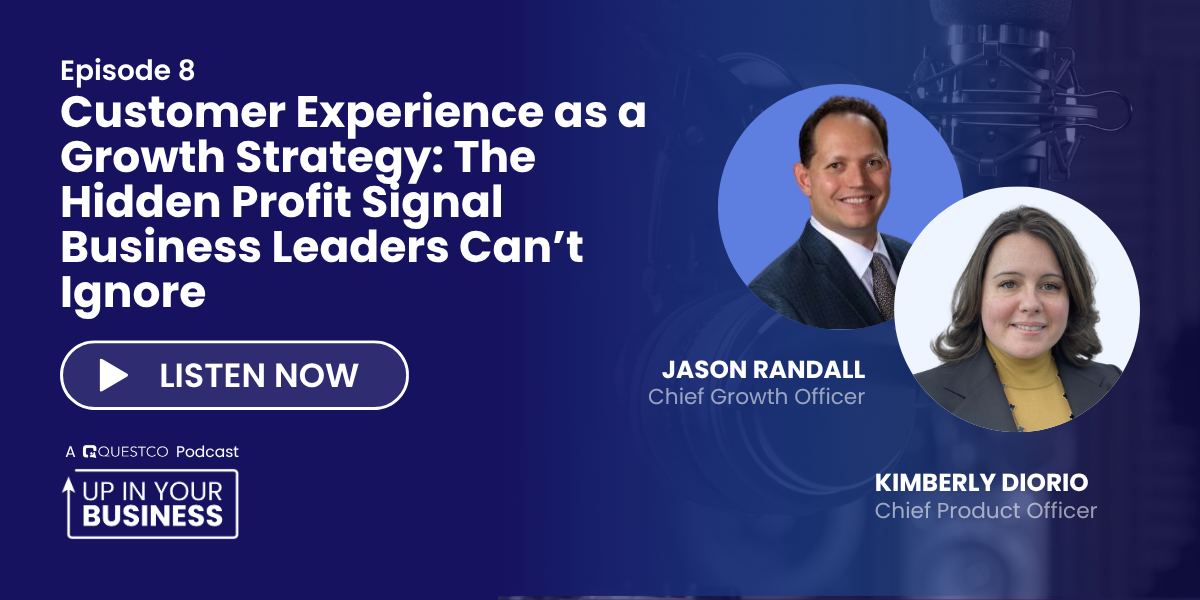
Customer experience is a financial signal, and its erosion is one of the most expensive problems a growing company can fail to notice. In the second episode of a three-part series on Up In Your Business, Questco Chief Product Officer Kim Diorio tells host Jason Randall that the experience behind the satisfaction score moves retention, pricing power, and cost to serve, and that it shows up as cost well before it shows up as lost revenue.
In this article, we go deeper into:
- what customer experience actually is, beyond NPS or a satisfaction score
- why it behaves like a leading indicator of business value
- how fast growth quietly erodes the experience that won your first customers
- the early signals that appear before anything reaches the balance sheet
- how to diagnose and protect the customer journey as you scale
Table of Contents
- What is customer experience, beyond a satisfaction score?
- Why is customer experience a financial signal and not just a satisfaction score?
- Why does customer experience erode exactly when a company is growing?
- What are the early warning signs before it reaches the financials?
- How do you tell a real problem from a one-off complaint?
- What does eroding customer experience actually cost?
- How do leaders diagnose and protect customer experience as they scale?
- What should leaders take away from this episode?
- Frequently Asked Questions
- Listen to the Full Episode
What is customer experience, beyond a satisfaction score?
Customer experience is the full journey a customer has with your business, from the first time they encounter you, through the buying process, onboarding, service, and renewal. The satisfaction score is the output. The experience is everything that produces it.
Most people picture a number when they hear the term, an NPS or a CSAT result. Diorio means something larger: the whole path a customer travels to consume the value you provide.
“From the time they are introduced to your organization through your buying process, whatever that may look like, all the way through to graduation.”
The buying experience is the first stretch of that journey, not a separate thing that happens before it. As Jason puts it in the episode, the score is the outcome of a whole set of things you have to dissect and understand before you can improve it.
Why is customer experience a financial signal and not just a satisfaction score?
Because it is the best leading indicator of business value. It moves retention, pricing power, and cost to serve, and those three together decide how profitable a customer relationship becomes.
“It is the best leading indicator of business value.”
The satisfied customer, Diorio explains, is the one creating the most value. They give you goodwill, they partner with you when things go sideways, they buy more, they refer others, and they stay the longest, which gives them the largest lifetime value.
“That satisfied customer is the one who is delivering value in multiple ways, staying for the longest period of time, they have the largest lifetime value.”
The research is blunt on this point. Bain & Company’s landmark work found that a 5 percent increase in customer retention raises profits by 25 to 95 percent. The same research explains why: acquiring customers is expensive, so many relationships are unprofitable in their early years, and they only produce real returns later, once loyal customers cost less to serve and buy more over time.
Bain & Company found that a 5 percent increase in customer retention raises profits by 25 to 95 percent, and that acquiring a new customer costs 5 to 25 times more than keeping one.
Why does customer experience erode exactly when a company is growing?
Because companies add customers faster than they add the capacity to serve them. Growth outruns the team’s ability to deliver a consistent experience, and the experience thins out.
Early on, a small team stays close to the customer. Service is high touch and personal, and the people delivering it understand what matters and what good looks like. Growth strains that.
“You’re bringing on customers faster than you can fill the capacity and the knowledgeable capacity.”
Diorio ties it back to clarity: the understanding of the journey lives in a few people’s heads instead of in the system. The founder’s instinct, writing a cell number on the back of a business card, stops working past a certain size, because that knowledge resides with one or two people rather than in the business itself.
Part of the cause is how companies fund growth. They invest in sales first, which is logical, because you have to generate volume before anything else. The mistake is stopping the thinking there. Service capacity has to be hired and ramped with enough lead time to meet the volume sales creates. When it is not, two things happen. The earliest customers watch the personalization they valued erode, and new customers hit a gap between what sales promised and what the company delivers.
The root cause tends to hide. Erosion often coincides with new leadership or new investment, so customers pin the service dip on those visible changes. Diorio’s point is that the real cause is usually the lack of systemization and trained capacity, not any lapse in intent.
What are the early warning signs before it reaches the financials?
The earliest signs are slipping conversion rates, longer sales cycles, rising escalations, and friction between sales and service. The financial signs, stalled expansion and missed renewals, come later.
Because Diorio counts the buying experience as part of customer experience, the first place erosion shows up is often the sales process. Conversion rates drop and cycles stretch, especially if the sales team was ramped quickly. Then escalations climb, and sales and service start blaming each other. Sales says service cannot deliver, and service says sales is promising things it should not. Only after that do customers stop expanding what they buy and stop renewing, which is when the problem finally reaches the balance sheet.
Signs to watch, in the order they appear
- conversion rates slipping and sales cycles stretching
- customer escalations climbing
- internal friction rising between sales and service
- existing customers no longer expanding what they buy
- renewals getting harder
The danger is that all of this is quiet. Teams firefight independently and try to make it right, and the problem compounds in the background until it turns up in the real numbers.
“Nobody comes to work wanting to do a poor job.”
How do you tell a real problem from a one-off complaint?
Segment your customers, stay close to the ones who were happiest before growth, and build listening that gives you signal at volume rather than a pile of anecdotes.
Diorio’s answer to overreacting is discipline, not paranoia. Identify your most loyal customers from before the growth phase and stay close to them. If they start to signal that things have slipped, that is worth acting on. Ideally you have a voice-of-customer engine that captures signal at scale, why deals are lost, why customers leave, and what happens during the buying process. In a less mature company, the customers and employees you already trust carry real weight, so survey new customers after implementation and check whether new hires can actually deliver what is expected of them.
The frontline usually sees this before leadership does, because they hear it in real time. Diorio recommends an advisory board. Questco recently stood up a sales advisory board of business development managers from different regions and tenures to surface what prospects are saying and to test changes before rolling them out. It is a lightweight way to hear whether a concern is shared across the team or an outlier. Pair it with a light quarterly pulse for employees and a few well-placed customer surveys at the moments that matter most.
There is also a question of who does the listening. Staying close to customers is always useful, but in growth mode the goal is a system-driven response. Rather than the founder diving in to solve issues by hand, the stronger move is to guide the team to the root cause and build a fix that scales. You need both a team resolving discrete issues in real time and a way to capture themes, so someone can fix the pattern at a global level instead of one ticket at a time.
What does eroding customer experience actually cost?
It hits three things at once: lifetime value, cost to serve, and pricing power. Together they compress margin even when this quarter’s revenue looks fine.
Diorio names two direct costs. Lifetime value falls, because a customer who stays but gives you less tenure is worth far less over time, even when the current revenue looks healthy. And cost to serve rises, sometimes sharply, because firefighting and reactive work dilute margin. Jason adds the third facet: pricing and goodwill. As the experience slips, you concede more on price, you lose referrals and engagement, and you eventually lose the customer anyway. The three move together, which is what makes the problem so expensive.
The research supports the shape of it. Bain’s work shows that loyal customers become profitable precisely because their cost to serve falls and their purchases rise the longer they stay, which is the same curve Diorio describes running in reverse when the experience erodes.
There is a deeper cost underneath the P&L. If the experience is not systematized, repeatable, and scalable, the business becomes less transferable over time. That goes to what the company is worth as an entity, not just this quarter’s numbers.
“It goes right to the heart of what the business is actually worth as an entity. It can be an existential issue.”
How do leaders diagnose and protect customer experience as they scale?
Three moves: map the journey as one journey, build repeatable systems, and segment customers by value and risk.
Three moves to protect customer experience
- Map the journey as one journey. Start with the key persona and the results you deliver, then walk the whole path from hello onward and name the moments that matter, what each should feel like and what result the customer should get. The work is to close the gaps between what you promise and what you deliver.
- Build repeatable systems. Great experience has to live in documented systems any trained employee can run, rather than in the heads of a few people. Systematizing the journey is also what lets you onboard and ramp new hires faster, which answers the capacity problem that started the erosion.
- Segment customers by value and risk. Group customers into the very satisfied, the most dissatisfied, and the middle. Study the satisfied cohort for shared traits and where you are underpricing, and for the dissatisfied cohort, fix the service themes rather than discounting.
On the first move, Diorio notes that a skilled facilitator can help, because an outsider asks the naive questions an internal team is too close to see, and that AI tools now put a structured journey-mapping session within reach for most companies. Look at your best experiences with your happiest customers, find what sets them apart, and build that as the standard.
On the third move, resist the instinct to discount. Discounting an unhappy customer compounds the problem, because the experience still is not fixed and now you have less revenue to fund the capacity that would fix it. Find the themes where service is slipping, make the investment, and show the customer you heard them.
One more effect is worth watching. As complaints get louder, teams lose sight of the happy customers and start to believe the company is not delivering value, which erodes the conviction a sales and service team runs on. Usually that is catastrophizing. A company growing fast is delivering something real, and the work is to fine-tune it and price for it. As Jason puts it, pride in what you deliver is what lets you ask for, and defend, the price the work deserves.
What should leaders take away from this episode?
Customer experience is a financial signal and a leadership discipline, and it is the second of Questco’s three C’s, after clarity and before culture. It shows up as cost, through rising cost to serve and falling lifetime value, well before it shows up as churn.
Catch it early by staying close to your happiest customers and building listening that gives you signal at volume. Protect it by mapping the journey as one journey, systematizing delivery so it does not depend on a few people, and segmenting by value and risk so you fix the right things and price for what you actually deliver.
This was Part 2 of a three-part series. The final conversation moves to culture.

Frequently Asked Questions
What is customer experience in business?
Customer experience is the full journey a customer has with a company, from the first sales conversation through onboarding, service, and renewal. Kim Diorio describes it as everything a customer goes through to consume your value, which is broader than a single NPS or satisfaction score.
Why is customer experience a financial signal?
Because it is a leading indicator of business value. It drives retention, pricing power, and cost to serve. Bain & Company research found that a 5 percent increase in customer retention can raise profits by 25 to 95 percent, largely because loyal customers cost less to serve and buy more over time.
Why does customer experience decline as a company grows?
Companies add customers faster than they add the capacity to serve them. Knowledge that once lived with a founder or a small team has not yet been built into systems, and businesses often fund sales before they fund the service capacity behind it.
What are the early signs customer experience is slipping?
Slipping conversion rates, longer sales cycles, rising escalations, and friction between sales and service usually appear first. Stalled expansion and missed renewals come later, once the problem reaches the financials.
How do you improve customer experience while scaling?
Map the customer journey as one journey and close the gaps between what you promise and what you deliver. Build repeatable systems so delivery does not depend on a few people. Segment customers by value and risk, invest in service where it is slipping, and price for the value you provide.
Does discounting fix an unhappy customer?
Usually not. Diorio argues that discounting an unhappy customer compounds the problem, because the experience still is not fixed and you now have less revenue to fund the capacity that would fix it. The better move is to address the service themes and show the customer the investment you are making.
Hear the full conversation with Jason Randall and Kim Diorio
Kim Diorio reframes customer experience as a financial signal, explains why it erodes exactly when a company is growing, and lays out how to diagnose and protect it as you scale. Listen to the full episode of Up In Your Business.

