
Topic Risk Management,
Why Organizational Culture is a Strategic Driver of Business Growth (UIYB S1E9)
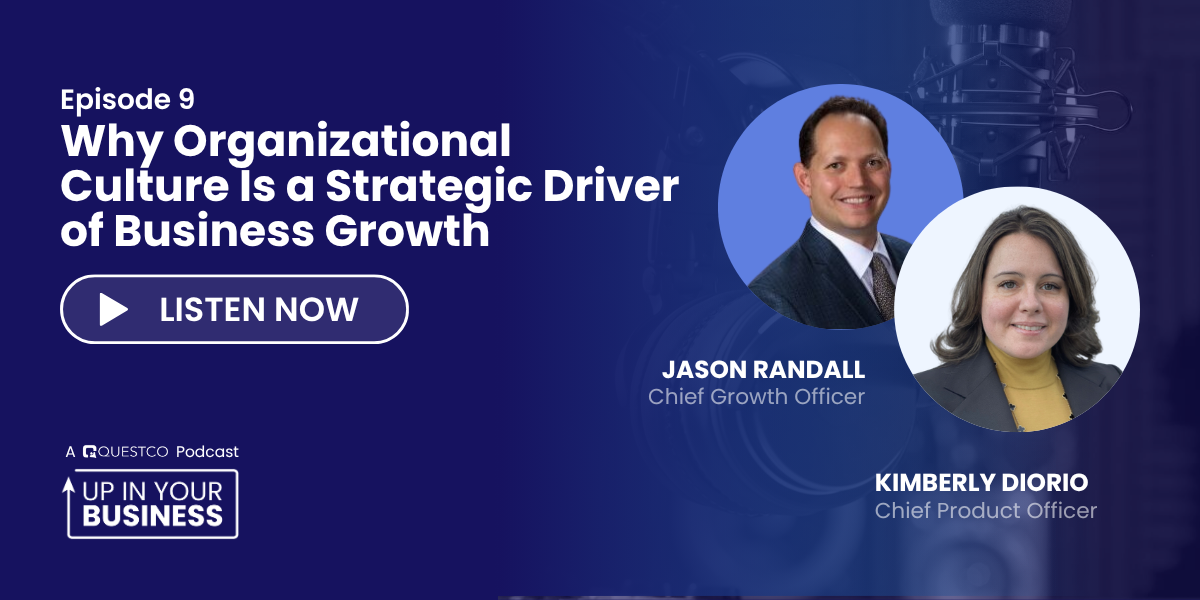
August 5, 2026 | By Questco
Culture is the quality of the decisions your people make when no one is watching, and whether that judgment can transfer to the next person who joins. In the final episode of a three-part series on Up In Your Business, Questco Chief Product Officer Kim Diorio tells host Jason Randall that culture is one of the assets most tied to enterprise value. When it thins during fast growth, the cost arrives as churn: churn of people, of discretionary effort, and of the institutional knowledge that makes a business worth buying.
In this article, we go deeper into:
- what culture actually is, beyond posters and perks
- the difference between a strong culture and strong personalities
- why culture thins exactly when a company is growing fast
- the early signs that appear before anything reaches the numbers
- what eroding culture costs, and why it ties to enterprise value
- what leaders should do first to make culture durable
Table of Contents
- What is culture, beyond posters and perks?
- What is the difference between a strong culture and strong personalities?
- Why does culture thin exactly when a company is growing fast?
- Where does culture break first, and what are the early signs?
- Why isn’t an employee survey enough to protect culture?
- What does eroding culture actually cost?
- How do leaders make culture durable as they scale?
- What should leaders take away from this episode?
- Frequently Asked Questions
- Listen to the Full Episode
What is culture, beyond posters and perks?
Culture is the quality of the decisions people make when no one is watching, and whether that judgment can be transferred to the next person who joins. The posters and perks sit downstream of it.
Diorio borrows the familiar line that culture is the way we do things around here, then makes it concrete. Culture is decision making and judgment: how choices get made across an organization, and whether that judgment is transferable or stuck with a few people. It usually gets filed as a softer, feel-good benefit. Her argument is that it has hard benefits, and that it is one of the things most tied to what a company is worth. Jason sharpens the definition to the quality of the decisions people make when no one is watching, the choices that happen after leadership has left the room.
“But what I’d love to dive into today is how it actually has hard benefits and is one of the things that’s most related to enterprise value at the end of the day.”
What is the difference between a strong culture and strong personalities?
A strong culture institutionalizes judgment, so everyone who joins decides the same way. Strong personalities only shape how a company feels while the key people are in the room.
Strong personalities show up in visible ways that are unique to a company. When something is embedded in the culture, the values are transmitted, and they carry all the way to the customer. Early on, decisions get made by osmosis, because the team is small and everyone sits close to the decision makers. A strong culture is what happens when that judgment gets systematized, so it no longer depends on proximity to a founder. Jason calls it turning mindset into a system: you do not have to have been in the room to carry the decision forward.
“When something is embedded in a culture, you have values that are transmitted and transmit to the customer.”
“When you have a strong culture, that decision making has become institutionalized. You’ve systematized it.”
Why does culture thin exactly when a company is growing fast?
Because fast growth outruns your systems. In a small company, judgment transmits by osmosis, but when hiring accelerates, new people are not close to the leaders who set the standard, and the informal transmission breaks.
The cause is usually not a lapse in values. It is a lack of systems. When you are small, you are in contact constantly and leadership sits close to the front lines, so judgment passes by osmosis. Hire fast and that stops working. New hires report to new layers of management, they are not in contact with the original decision makers, and sharing what works systematically with everyone who joins becomes the hard part. What actually breaks is the communication, and the transmission of history and the decision-making process. The fix Diorio points to is a strong set of standards, guidelines, and guardrails, so people can operate inside the culture you want without a leader in every room.
“Typically it’s because of a lack of systems.”
“You can’t be in every room or in every conversation making every decision on behalf of the entire team.”
Where does culture break first, and what are the early signs?
It breaks first where people stand in front of customers: the sales team and the service or delivery team. The earliest signs are stretching ramp times, onboarding that leaves new hires struggling alone, and the same work looking different from one team to the next.
Back-office functions can feel it, but Diorio sees it most on the sales team and the service or delivery team, where people are out in front of other humans, selling or delivering against expectations someone else set. The early signs are quiet. New hires take longer to become effective, ramp times stretch, and onboarding starts to look like people figuring it out on their own, with no buddy system and often made harder by remote work. Look across teams and the same work starts to look different depending on the manager.
The early signs of a thinning culture
- New hires take longer to become effective, and ramp times stretch
- Onboarding looks like people struggling on their own
- The same work looks different from one team or manager to the next
- Discretionary effort drops, and your best people quietly carry more than their share
The signal Diorio watches most closely is that last one, discretionary effort. Where you used to get extra, people start to do less, and the imbalance shows up as your most tenured people carrying the load the new hires cannot yet carry, because the culture is not transmitting.
“The production and the delivery may look very different across teams. So that’s a pretty clear sign that the culture and the process and the decision making aren’t systematic.”
“You have the best people carrying significantly more than their share and picking up the pieces for others.”
Why isn’t an employee survey enough to protect culture?
Because asking for feedback is not the same as systematizing culture. If the standards and the way decisions get made are not written down, people may not even know how to point you to the problem.
Regular surveys, town halls, and open-door policies feel like staying on top of it. Diorio’s caution is that asking how things feel is not enough if you are not being intentional about clarifying and outlining, for everyone, what the culture is, what decisions get made, and how. People say they do not want to be told what to do, but in a way they do. They want clarity. There is also a distinction worth holding onto: satisfaction and culture are two different things. Satisfaction comes from people knowing what success looks like and having the support to reach it. Most people come to work wanting to do a great job, and they succeed if they can. Culture is a level up from that. It should be a function of the outcomes you are trying to deliver, tailored to who you serve, rather than a read on how happy people feel this week.
“Most people come to work wanting to do a great job. People succeed if they can.”
“The culture should be a function of the outcomes you’re trying to deliver.”
What does eroding culture actually cost?
It costs churn, three kinds at once: churn of people, churn of discretionary effort before anyone leaves, and churn of the institutional knowledge that walks out with them. Underneath the P&L, it makes the business more fragile and harder to sell.
Diorio summarizes the hard cost in one word: churn. You see churn of your people. You see churn of discretionary effort, often before anyone actually resigns. And you see churn of knowledge, because when it lives in one person’s head and that person leaves, or even just moves teams, the institutional knowledge goes with them.
“If knowledge is in one person’s head and they leave, you lose that institutional knowledge.”
The deeper cost sits under the income statement. When judgment cannot be transferred and the business runs on a few people’s heads, the company becomes more fragile, and so does its growth. That transferability is directly tied to what the company is worth. As Jason puts it, this is about dollars at the end of the day.
“Investors and buyers, they pay for execution and they pay for predictability.”
A fragile culture runs on heroics and on knowledge locked in individual heads, so results are not repeatable and growth is not predictable. That makes the business worth less and harder to hand off. Make judgment transferable and you make the company more durable, and more valuable.
How do leaders make culture durable as they scale?
Four moves: make the standards explicit, keep a decision log, build judgment into onboarding, and systematize knowledge so it lives in the company rather than a few heads. And treat it as every leader’s job, not only HR’s.
What to do first
- Make the standards explicit. Write down what good judgment looks like.
- Keep a decision log. Capture significant decisions and the logic behind them, so the team can decide consistently over time.
- Build it into onboarding. Put the standards and guardrails into onboarding so new hires learn good judgment fast.
- Systematize the knowledge. Get it out of individuals’ heads and into processes and systems, accessible to everyone.
Diorio is explicit that this is not only HR’s job. Questco’s contribution is predictability and durability through process and compliance, taking certain decisions off a company’s plate so it can focus on growth. But that is one piece. Every business operator contributes to the culture and owns making their part of the company as durable as possible.
“Making the standards explicit, writing down what good judgment looks like.”
“Get it out of individuals’ heads and into processes, systems, and making it democratized and accessible.”
What should leaders take away from this episode?
Culture is a strategic driver, the third of Questco’s 3 C’s, after clarity and customer experience. Its failure mode is churn, and its payoff is a business whose results are transferable, predictable, and worth more.
Culture is the quality of the decisions people make when no one is watching, and it decides whether your results can outlast the people who produce them. Catch the erosion early by watching ramp times, cross-team consistency, and discretionary effort. Make it durable by writing standards down, keeping a decision log, building judgment into onboarding, and systematizing knowledge. This was the final conversation in a three-part series. Together, the 3 C’s and the three self-assessments are a complete diagnostic for what breaks when you grow, and how to protect it.
Frequently Asked Questions
What is culture in a business, beyond values on a wall?
Kim Diorio defines culture as the way we do things around here, and specifically as the quality of decision making and judgment across an organization, including whether that judgment is transferable. Jason Randall frames it as the quality of the decisions people make when no one is watching.
Why does culture thin when a company grows fast?
Typically because of a lack of systems. In a small company, leadership is close to the front lines and judgment transmits by osmosis. When hiring accelerates, new people are not in contact with the same leaders, new layers of management appear, and the transmission of history and decision making breaks down.
Where does a weakening culture show up first?
Most often on the sales team and the service or delivery team, where people are in front of customers. Early signs include ramp times stretching, onboarding that leaves new hires struggling on their own, the same work looking different across teams, and a drop in discretionary effort.
Why isn’t an employee survey enough to protect culture?
Because asking for feedback is not the same as systematizing culture. If standards, decisions, and judgment are not made explicit, employees may not even know how to point you to the problem. Satisfaction and culture are also two different things; culture should be a function of the outcomes you are trying to deliver.
What does eroding culture actually cost?
Diorio summarizes it as churn: of people, of discretionary effort before anyone leaves, and of institutional knowledge. Because judgment stays locked in individuals, the business becomes more fragile and harder to transfer, which ties culture directly to enterprise value.
What should leaders do first to strengthen culture?
Make the standards explicit and write down what good judgment looks like, keep a decision log that captures big decisions and the logic behind them, build those standards into onboarding, and systematize knowledge so it lives in processes and systems rather than a few people’s heads.
Hear the full conversation with Jason Randall and Kim Diorio
Kim Diorio reframes culture as a strategic driver, explains why it thins exactly when a company is growing, and lays out how to make it durable as you scale. Listen to the full episode of Up In Your Business, and complete the 3 C’s series.

